
breaking the wheel
There is a growing debate in the field about whether marketing has been reduced to an activity and has lost its position as an academic discipline built to run across the whole business. That it has morphed into a department that produces campaigns, and its original purpose has become muddled and lost.
The argument remains unresolved, particularly in B2B, where academic research has historically lagged behind that of B2C and brand strategy. The general consensus seems to be that this is something the discipline has done to itself. Yet the purpose of marketing, as a topic, is gaining traction in the B2B community and being taken seriously. The pandemic, the rise of AI, a competitive job market and tightened budgets across the board mean that managing directors and CFOs, not just marketing heads, now have reason to take it seriously too.
When I started to unpack this, a quiet discontent started to grow around how the marketing function is understood and experienced day-to-day, both by those inside it and those working alongside it. So I went back to the foundational texts, and what I found is that the models marketing has been built on do not help as much as they should in today's market. The discipline settled decades ago on a small set of categories, the four Ps among them, because they took a complicated subject and packaged it into something that could be more easily understood and managed. The approach was, and still is, foundational. But it creates tension with branding and creative delivery, and, set against them, it can feel like a checklist that misses the point.
In more recent years, the models have been replaced with the now-infamous wheel, and describing marketing as a system has become a common theme. The wheel seems to have leapfrogged the funnel, and with good reason: it reflects how marketing operates from the inside. Plan, iterate, measure, review, plan, iterate…round and round it goes.
The risk is that a wheel, and any marketing framework that looks good as a one-pager, cannot capture the real work that is required within a growing, specialist business. It continues to reduce marketing to a delivery function, long overdue for a return to its vital strategic backbone role, aligned with product, sales, and support. Too often, this level of marketing, the CMO level, is treated as the preserve of enterprise, where capacity and resources can be addressed with budget. That assumption is part of the problem. Marketing has real faults as a standalone discipline. It is unwieldy and hard to justify. But if there is one thing the research agrees on, it is that it cannot be run from inside a single model or shape.
The funnel gave way to the wheel, and the wheel will give way to what follows. Each model is useful, but for a business whose marketing has never quite delivered what was expected, the question is not which model to adopt next. It is about whether the function has been built with intention, scale, and alignment, with a focus on putting the customer at the centre. That is why training in strategic thinking holds true value. It cannot be commoditised, and the context on which the strategy is built cannot be modelled by AI. In fact, it is taking the time to invest in the function upstream of delivery that makes the model of the moment, the latest tools, and ultimately the customer positioning, deliver real value.
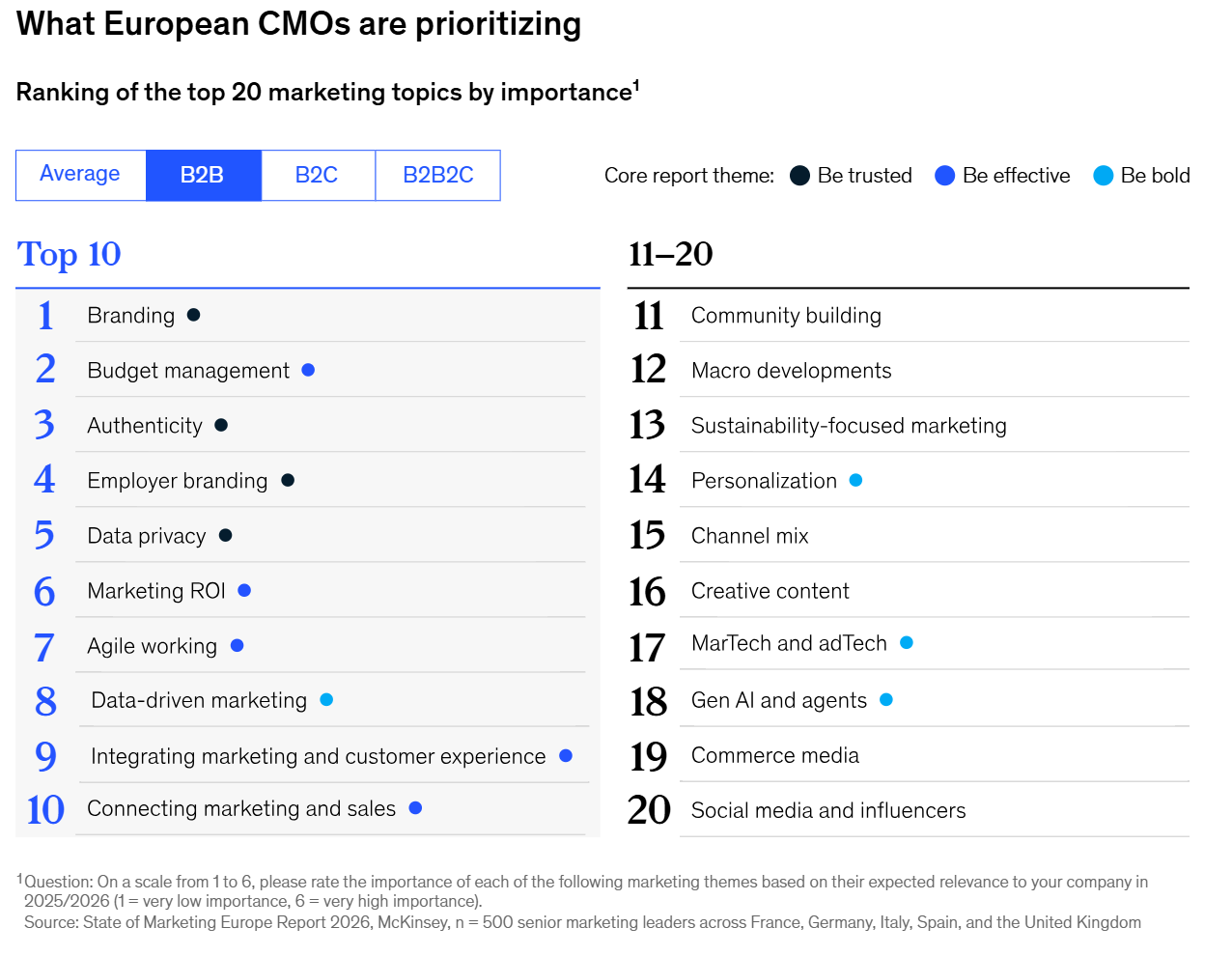
Mckinsey State of Marketing Europe 2026: https://www.mckinsey.com/capabilities/growth-marketing-and-sales/our-insights/past-forward-the-modern-rethinking-of-marketings-core
