
B2B Tech Growth Architecture
Why Capability Comes Before Visibility
When marketing in a specialist B2B business appears to be underdelivering, the instinct is to keep building delivery, brand awareness, or social reach. In market-mature businesses with an established marketing function, underperformance can often be addressed by shifting brand, PR, or content strategy, since they have the budgets and resources to pivot.
For smaller businesses, especially those at the intersection of 'business as usual' and ambitious growth, spending on reach to enable growth seems like a logical step. But what usually happens is that the growth machine starts operating before the defining function or structure is built. This is where marketing budgets quietly disappear and the metrics don't align with growth expectations.
The multiplier of complexity
Once a business reaches a certain point in its growth journey, a whole range of complexities start to show. In a small business, a few people hold the knowledge and the structures, systems and processes are organic; they know the product, the customers and the story. They instinctively know who they want to tell the story to.
As the business adds products, markets, partners and distributors, complexity multiplies. Larry Greiner described the organisational version of this in 1972: businesses grow through long stages of steady evolution punctuated by revolutionary crises. The first stage comes when informal communication and founder-led control can no longer hold a larger organisation together.
Enterprise marketing has its own responses to this, in frameworks like the Google and Boston Consulting Group marketing maturity models, while specialist B2B models at SME level think in terms of the traditional sales funnel, but shift focus from spend at the top for awareness down to retention and advocacy. What none of them address are the absolute fundamentals: structure, systems and process.
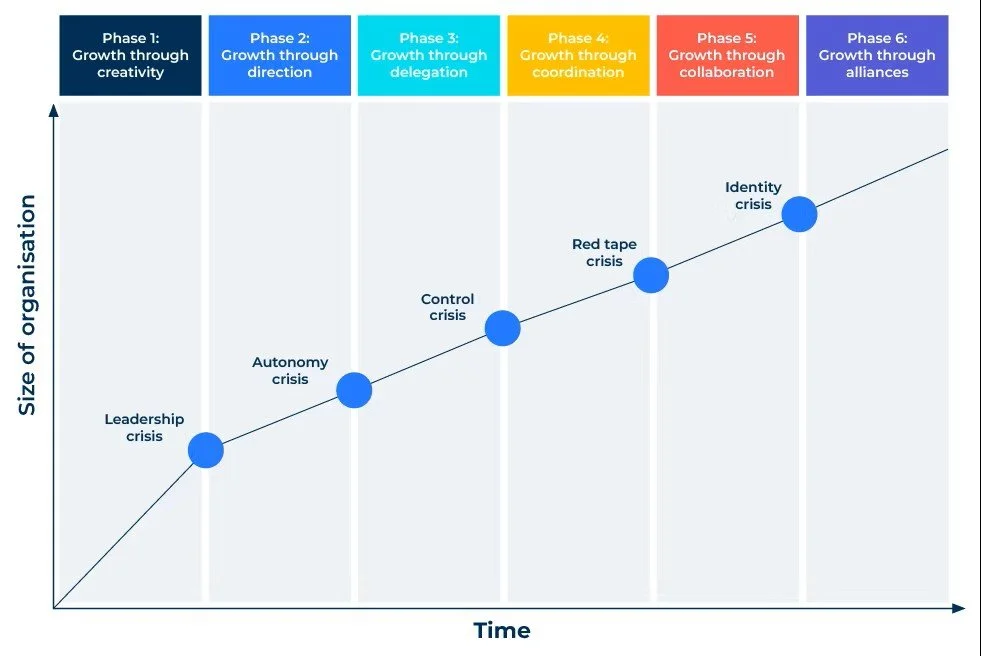
Greiner's Growth Model:
https://www.b2bframeworks.com/frameworks/greiner's-growth-model
Before building and releasing any growth machine, it is vital to understand what the business can and cannot yet do. True organisational capability is not a software licence you buy, nor is it a set of siloed marketing skills; it is an emergent property of alignment. As design theorist Jay Galbraith illustrated in his classic Star Model, an organisation's capability only exists when its strategy, structure, processes, and systems are explicitly engineered to pull in the same direction.
When a growing B2B firm pushes for visibility before establishing this structural harmony, it doesn't solve its complexity problem; it just pushes leads into a disconnected business and puts high pressure on a fractured engine.
This structural mismatch is exactly what happens when technology outpaces architecture. As far back as 2012, I worked within businesses that had the basics in place: a CRM, email marketing, a website, finance and production systems. The systems were established but mostly disconnected. The data, while starting to provide insights and help make better decisions, was sprawling and hard to visualise.
Marketing and business tech moved on quickly to address these issues. Just five years later, it was possible to layer personalisation tools, build automation workflows and construct a visual business intelligence layer for reporting. Each addition was worthwhile, but each was added incrementally. With the tech being so new, the business lacked a coherent tech-stack strategy. There were systems, but they lacked structure and process.
Marketing is now again at an intersection, as many business operations are, with AI dominating the conversation at the enterprise level. There's no doubt that, like all the other models and tools that came before it, AI will transform how marketing and sales scale, providing insight and informing strategy. But the question to ask isn't how AI can be implemented for a business; it's whether the business even has the fundamentals in place to harness the benefits that transformation offers, rather than sinking budget into a different money pit.
